Wednesday, 19 July 2017

Writers who chat (and eat cake)

Day 10 of the journey - our heroine meets a companion

‘All for one and one for all!’ That's the succinct statement of comradeship devised by Alexandre Dumas for his famous quartet. The ‘true companions’ trope is excellently illustrated by d’Artagnan and the Three Musketeers. 

You'll find it used often in novels and films where the hero meets a like-minded person or persons on his journey, forming a ‘band of brothers’ who watch out for each other. Sometimes the companionship is brief but nonetheless the hero is strengthened by the friendship.

Such is the solitary nature of writing we don't often meet our companion scribes. But there are forums, Facebook and Twitter where writers can meet online to support each other. For example, I've just finished a most enjoyable hour on Twitter using the #writingchat hashtag to talk with my fellow writers. (The event happens every Wednesday, 8-9pm if you're a writer and would like to join in.)

But great though social media is, how much better it is when we get the opportunity to meet a fellow scribe in person. I met with two such colleagues earlier in the year, and another today. Although we have known each other online for a few years, it was lovely finally to sit down together and chat in real life. (An added bonus for me is that my companion today is an excellent baker of cakes.)

I wonder what the statement of comradeship should be for writers who chat? Perhaps ‘All for cake and cake for all!’ would be a suitable rallying cry.

Victory is mine

Day 9 of the journey - our heroine regains control of the mysterious artefact

Returning to halls after Christmas, during our first year at university, my room mate and I discovered this wooden gavel inside the wardrobe. 

The university had let out the residential halls over the holiday period to a conference and presumably one of the delegates had left the gavel there by mistake. (What sort of conference, and why the delegate was in possession of the wooden hammer, we never did find out.) We dutifully handed it in, but as no one came forward to claim it the gavel was returned to us to do with as we wished.

The difficulty was, my room mate and I both wanted to keep it as a souvenir. We considered tossing a coin, or perhaps playing Paper, Scissors, Stone to decide who would win custody. But eventually we decided on joint ownership, each of us taking a turn at being the custodian of the gavel. And so each time we meet (on average once a year, sometimes shorter but often a longer period) the gavel is ceremoniously handed over. It has become a motivating element in the 41 year story of our ongoing friendship. 

The gavel has become our ‘MacGuffin’, our ‘weenie’, our thingamijig. In fiction, particularly in films, the MacGuffin is the word used to describe the mysterious artefact, the priceless jewel, the secret papers or whatever it is that the characters seek. The search for it is something that drives the plot forward.

Yesterday my journey took me back to our Alma Mater. Today I return victorious, having acquired control of the MacGuffin. 

Monday, 17 July 2017

University - then and now

Day 8 of the journey - our heroine goes in search of knowledge 

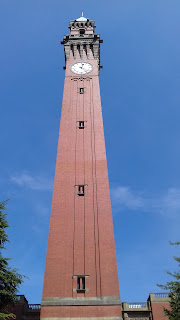
Today I visited Old Joe. Over 40 years ago I consulted Old Joe on a daily basis. This was to check whether I would be late for my next lecture: I usually was.

Old Joe is the affectionate name given to the 325 foot tower which stands in the centre of the University of Birmingham’s campus. It is in fact the tallest free standing clock tower in the world. I only found out that fact today, although I may have been told many years ago. There is much I have been taught but which I have now forgotten.

A standard fictional convention is when the hero visits a hermit or wise man in search of knowledge to help in his quest. Knowing how unreliable my own memory is, it does make me wonder whether the old sage will always provide the right information. 

But then wisdom is about more than facts. Perhaps the truly wise person is the one who accepts that he doesn't have all the answers.

In the 40 years since I was a student here much has changed: trees have grown taller; buildings have been demolished, including Ridge Hall where I lived; others have been built in their place; the paternoster lifts in the Arts building have been removed. 

Yet despite all the changes Old Joe is still there. 

And my timekeeping is no better!


Truth and Lies

Day 7 of the journey - our heroine must decide between truth and falsehood

I've left behind my Hawarden book haven and headed south along the Welsh border, round the Wrekin and am now in Shropshire. In the midlands they use the phrase ‘going round the Wrekin’ to mean taking the long way round, similar to the ‘round the houses’ expression used elsewhere. 

If you haven't heard the name before, the Wrekin is a local hill. Some people believe it to be an extinct volcano. Apparently this is not true.

There is another theory. It is said the Wrekin was formed when a load of earth was dumped on the ground by an angry giant. Maybe this is true.


The local river, the Teme, is renowned for its bearded monsters. Apparently this is true.

If you walk by the Teme in early evening as the sun is setting you will not be bitten by midges. This, most unfortunately, is not true.

Saturday, 15 July 2017

Slumbering

Day 6 of the Journey - our heroine walks amongst the dead

My room overlooks St Deniol’s church in Hawarden. Like many people, I find old churchyards fascinating. I walked around reading the gravestones, trying to piece together the stories of people’s lives. Some of the graves date back to the 1600s and 1700s. There are also some war graves here, including one from the Crimean War. One man appears to have buried three wives in the same grave: I wonder whether they all did ‘rest in peace’ as the inscription urged them to do or whether there was some ghostly fighting between the women.

Some inscriptions are simple, others more flowery. Many have scripture verses, poetry or hymns embossed. There are a few euphemisms used, death too harsh or upsetting a word. The most frequently used is to describe the deceased as someone ‘who fell asleep’. As a child that gave me the heebie jeebies. The poor old man, I would think, he only nodded off for a minute and his family buried him before he could wake up!

There are other attempts: ‘Who departed this life’; ‘Was called home’; ‘Who passed on to higher service’

Then there is this verse on the grave of 24 year old John Jones which begins as if to offer comfort, but to my mind succeeds only in sounding like a threat:

‘Weep not my wife and children dear
A tender father lieth here
My death you know, my grave you see,
Prepare yourselves to follow me’

Sleep tight, my friends.

Friday, 14 July 2017

Reflections on the rolling waves


Day 5 of the journey - our heroine runs away to sea

I went to the seaside today. I watched children and dogs playing on the sand and running in and out of the waves. I narrowly missed being knocked over by a group of teens, their faces flushed with excitement as they returned to shore after a sailing lesson. I ate some deliciously upmarket fish and chips. I walked on the promenade and drank a cappuccino while the tide rolled in. All very enjoyable.

Then I became somewhat reflective. You know the sort of thing - the sea’s so big that our lives seem insignificant; what lies beyond the horizon, etc

The sea has always provided inspiration to writers. Running away to sea is a constant recurring storyline, the very stuff of adventure tales. Stories such as Treasure Island by Robert Louis Stevenson, the classic running away tale of Jonah and the Whale, poetry such as John Masefield’s Sea Fever (‘I must go down to the seas again, to the lonely sea and the sky’) - the list goes on. 

Maybe tomorrow I’ll draw on that inspiration and write a sea inspired story. Although it will probably be more about paddling and sand castles than pirating and swashbuckling. But then, why not, perhaps I could try something a little different? 


Thursday, 13 July 2017

Quest for Quietness

Day 4 of the journey - our heroine sets out on a pilgrimage.

I am in library heaven. Gladstone’s Library is a wondrous place. I have wanted to come here for a long time and today I made that dream a reality. It was founded by former Prime Minister William Gladstone, opened in 1902 and became a residential library in 1906. There is a serenity to the place which I can't fittingly describe. The library itself is all polished wood and large tomes. The librarians speak only in whispers. There is no other sound apart from the gentle tapping on keypads.

The facilities are good too. The ‘Food For Thought’ bistro provides good food at reasonable prices. There is a separate lounge with deep cushioned armchairs and an honesty bar.  My ensuite bedroom is comfortable, with a view across the churchyard of St Deiniol’s.

Hawarden is just a mile away from the small village where I was born so I went on a pilgrimage. I think I found the right place although I can't be sure. I didn't recognise it from the last time I was there; I was probably too preoccupied being born. Somewhat disappointingly there was no plaque on the wall to record the birth of Mancot’s famous (or perhaps infamous?) daughter. One day, maybe.

And when I returned from my walk along the country lanes of North Wales, I sat in the library and did some real writing. Which is what my quest was intended to achieve.